METRONEWS
© New Zealand Broadcasting School 2025

Robot Kōkako finishes two week trial: plans to lure the bird in

Marcus Allan
kokako in bush
The kōkako animatronic that has survived the North Canterbury bush for the last two weeks.   Phil Bones/Supplied

The first trial of an animatronic Kōkako finished today after two weeks in the North Canterbury bush, working to lure the bird in if there is still one alive. 

The location of the robot is undisclosed due to the property owners' wishes, but it was confirmed to Metro News that the location is one where a recent unconfirmed sighting was reported.

The bird is powered by seven servo motors and batteries to make it move, and call, like the elusive bird. It is surrounded by seven cameras, catching every angle of the bird.

South Island Kōkako Trust manager, Inger Perkins, said the cameras will also observe if any birds have behaved differently. Recorders will catch bird calls.  

“We're hoping it will draw in the birds and that, you know, something like a kea won't come and pull it apart. It’s a trial.” 

If alive, there are likely only one or two of the elusive species out there.  

In 2007, a $10,000 reward was issued by the South Island Kōkako Trust. DOC labelled the bird extinct in 2008, but it was re-classified as data deficient 5 years later. 
  
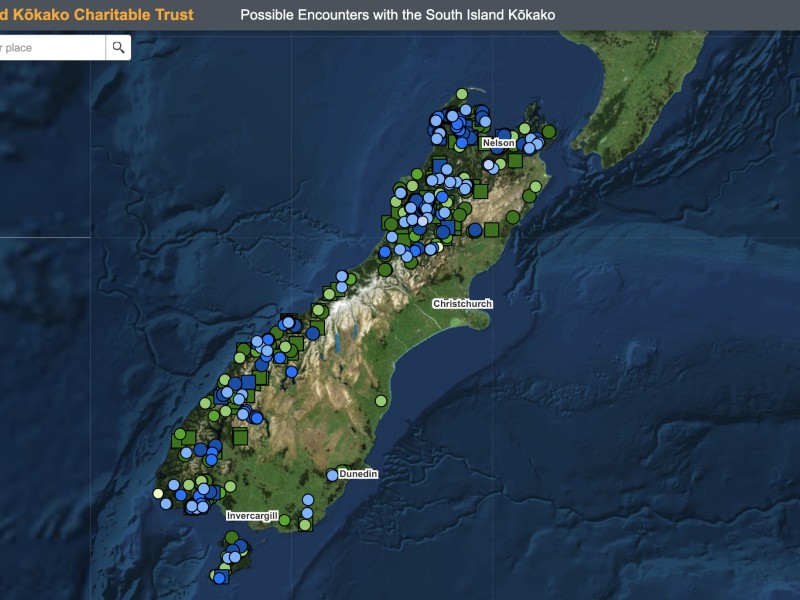
A map on the trust’s website shows reports across the South Island, from the top, down the West Coast, into Fiordland, Southland and Stuart Island.  
 
Perkins said initially they’d hoped the map would show clusters so they could focus on those, but it's much more widespread than they had realised.

Screenshot 2025 11 25 at 4.35.26 PM
A map showing all the unconfirmed sightings to the trust Jordan Miller/South Island Kōkako Charitable Trust

Five University of Canterbury students started the project, but it has since been taken over by retired Professor of Electrical and Computer Engineering, Phil Bones.  
 
It began as a conversation between Bones and Perkins two years ago, after she noticed his email signature when he got in touch on another matter. Following that conversation, Bones added it as a project for final-year engineering students at the University.  
 
Perkins said they have tried with stationary models of the bird in the past.

"This was a tool that we've wanted to bring into our toolbox for years and years and years.” 
 
Bones said that since its placement, it had faced heat and three major rainstorms in the first week.  
 
He said when he checked it at the halfway point, it looked a bit “bedraggled”.  
 
“It had also run out of battery, so I thought originally that the battery could last two weeks, but it clearly can’t in its current configuration.” 
 
Now with the model back from the location, Bones said this was one of the things that would need to be changed for prototype two.  
 
“My plan would be to come up with a second prototype, an improved model, that may be a little bit easier to manufacture than the current one.”  
 
However, funding will be needed for this project to continue. Bones said once the model is final, half a dozen will be needed. 
 
“It will be pointless only having one.” 
 
He said the first prototype cost close to $10,000, and while the first prototype is always more expensive, this does not include labour costs.  
 
He predicted the number needed could cost upwards of $50,000 
 
“Anybody out there with spare cash in these cash-strapped days...we’ll be looking for funding.” 
 
Perkins said funding is difficult to get, and there are questions around which species' research should be funded.  
 
“Should it be put into the ones where we know we've got a good base, or should we be putting it into these ones right on the edge of extinction. 
 
“It's a very difficult one, and it's hard to get funding for what we are doing, but we still believe in the value of what we're doing.” 
 

IMG 8625
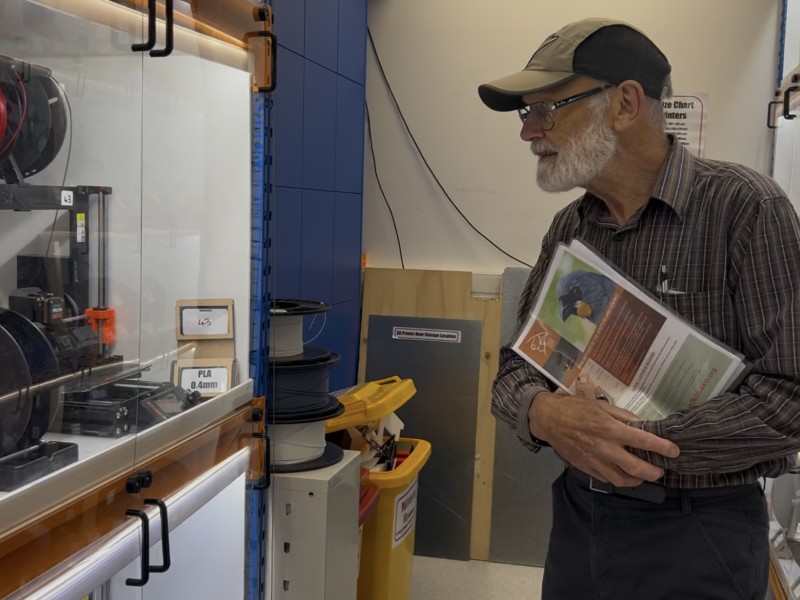
Professor Phil Bones admiring the 3D printer responsible for making parts of his bird. Marcus Allan/NZBS

It comes after 8 unconfirmed sightings of the bird were reported to the trust in the 3 months to the end of October. These ranged from “possible” to “sorry, not this time”.  

The most promising was on the Old Ghost Road in northern Buller in late July, where a man said he heard the same call as one posted online. He was about 1.75km south of Mokihinui Forks Hut.  

On their website, Perkins says that “While the bird wasn’t seen, our experts think there’s a good chance a South Island kōkako was heard.  

“We received another report further south, south of Lyall Saddle Hut. We’re still waiting for more details for that report, but if the OGR is on your agenda in the coming months, please try to keep ears and eyes open.” 

Perkins urged trampers to also record any sightings, rather than reporting just what they saw.  

“Ideally, if they get a moment to grab a phone, get a camera, get the recorder on, and the recorder of the movement, the recorder of the song, that helps us enormously.” 

She said if you are heading into the bush, have a look at their website at their map of sightings, so you know if you are in an area of interest.